Recently Abdul El-Sayed suggested in an interview, and many in the world perceive, that Pakistan is an ethnoreligious, narrow, homogeneous and monotonous country. But that is far from the truth.
Although there were people in the past, starting from the Muslim League (ML) and Sir Zafrullah (whose own sect became the first target of his own plan) to the dictator Zia ul Haq and other religious and rightwing parties, who tried to make Pakistan narrow and homogeneous and also tried to oppress minorities in every way possible during the process, be it by constitutional measures or by sociocultural and socioreligious pressures.
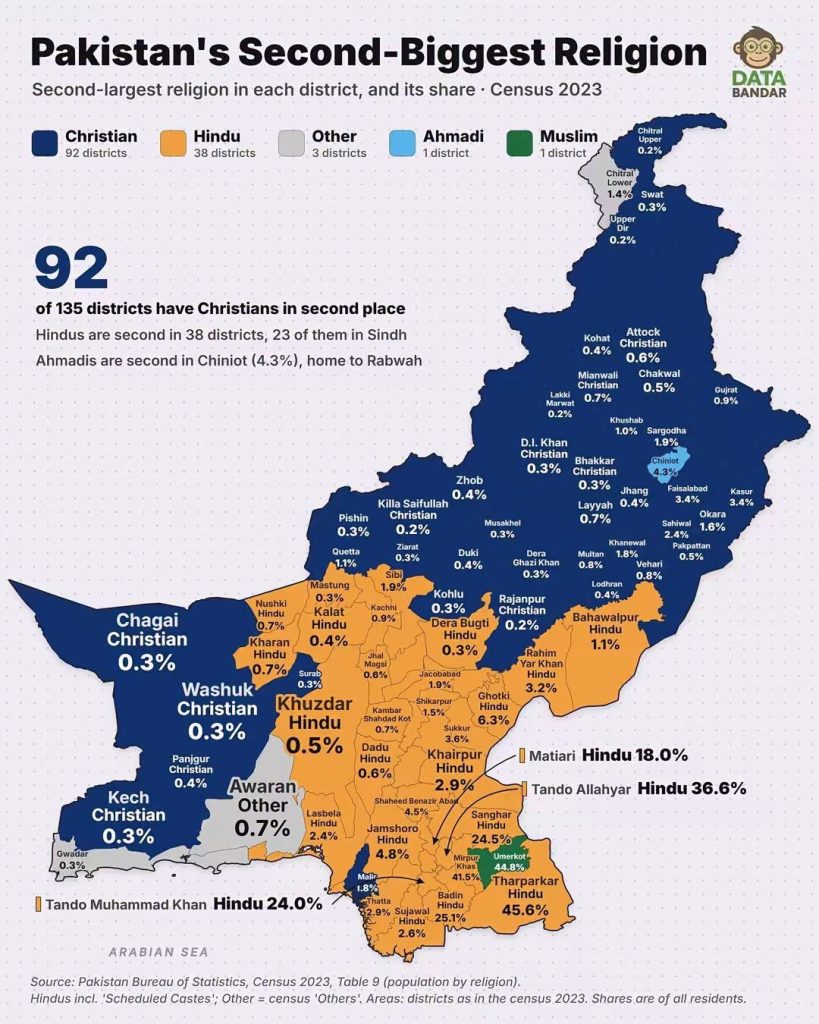
However, Pakistan is so ethnically, religiously, culturally and linguistically diverse, vibrant and multicultural that only a handful of countries in the world can claim that. For example, there are over 70 languages spoken in Pakistan, six major and dozens of minor ethnic groups, and people from many religions as shown in the attached picture (data from Census 2023, graphic by Data Bandar, shared by Adnan Rehmat).
We are lucky to have this much diversity and multiculturalism. We must celebrate this and also the fact that we inherit one of the world’s oldest and greatest civilisations, built around our Indus, the Indus Valley Civilisation (IVC). We should own our history, culture and civilisation, be proud of it and not let others steal this legacy.
Since 1947, we have developed our own distinct and special culture, heritage, language and international standing, competing with the world in the process. All of this together, alongside delegation of rights, freedoms, true democracy and powers to provinces and ethnicities, could make the country progress and do better for everyone. Whoever tells you otherwise is the enemy of you and your future.
Remember, people make countries, countries don’t make people. So people come first and everything associated with them must be owned, respected and celebrated.
Dr. Akif Khan
Leave a Reply